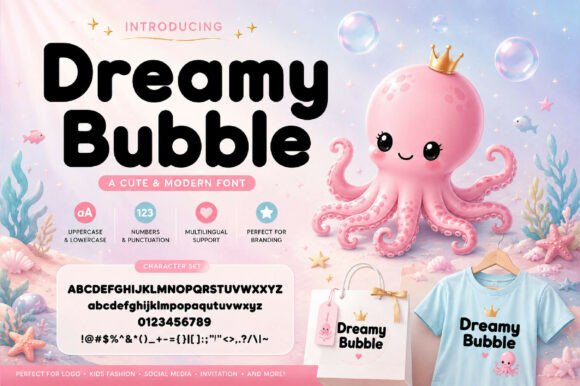
Introducing Dreamy Bubble: How to Use This Playful Font Without Sacrificing Professionalism
In the crowded landscape of typography, finding a font that strikes the perfect balance between whimsy and utility can be a challenge. Enter Dreamy Bubble, a delightfully rounded display font designed to infuse a touch of magic and charm into your creative projects. Whether you are a small business owner designing a new logo, a teacher creating engaging classroom materials, or a marketer looking to soften a brand’s image, Dreamy Bubble offers an inviting, cheerful tone that is hard to ignore. However, while its bold, bubbly letterforms are visually appealing, using a font with such a distinct personality requires a nuanced approach to avoid common design pitfalls.
Understanding the Essence of Dreamy Bubble
At its core, Dreamy Bubble is a display typeface characterized by its soft shapes, rounded edges, and effervescent character. Unlike standard serif or sans-serif fonts meant for long-form reading, Dreamy Bubble is crafted for impact and emotion. Its welcoming aura makes it an excellent choice for headers, logos, and social media graphics where you need to capture attention instantly. However, the very features that make it charming—its boldness and roundness—can become liabilities if misapplied. To truly leverage the power of this font, one must understand not just how it looks, but how it functions in different contexts.
Avoiding the "Wall of Text" Trap
The most frequent mistake beginners make with playful display fonts like Dreamy Bubble is using them for body copy. It is a tempting thought: if a font looks this friendly, surely it will make my entire newsletter feel warm and inviting? In reality, this is a decision that can severely hamper usability.
Dreamy Bubble is designed for headlines and short bursts of text. Because of its rounded structures and bold weight, using it for long paragraphs creates a phenomenon known as "visual fatigue." The uniformity of the bubble shapes can make large blocks of text appear blurry or overwhelming to the eye. This hurts readability and can cause visitors to bounce from your site or skip reading your printed material.
The Better Approach: Use Dreamy Bubble exclusively for your H1, H2, and H3 headers, or for short calls to action. For the body text, pair it with a clean, neutral sans-serif font. This creates a hierarchy that guides the reader's eye, allowing the playful nature of Dreamy Bubble to shine without overwhelming the message.
Context is King: Knowing Your Audience
While Dreamy Bubble is a fantastic choice for energizing designs, it is not a one-size-fits-all solution. A common oversight is applying the font to professional contexts where authority and seriousness are paramount. Imagine receiving a legal contract or a financial audit report written in a bubbly, rounded font. The visual dissonance would instantly undermine the credibility of the content.
This is where understanding the "personality" of typography matters. Dreamy Bubble exudes a friendly, jovial atmosphere. It is perfect for:
- Children’s Education: Worksheets, storybook covers, and classroom posters.
- Food and Beverage: Bakeries, ice cream shops, or bubble tea labels.
- Event Planning: Birthday invitations or baby shower announcements.
However, if you are working in sectors like finance, law, or heavy industrial manufacturing, Dreamy Bubble might send the wrong signal. It suggests a casualness that might not align with the expectations of your clients. Before downloading or purchasing, always ask: Does this font match the emotional weight of my industry?
The Myth of "One-Size-Fits-All" Sizing
Another detail often overlooked is how rounded fonts behave at different scales. Dreamy Bubble looks stunning at large sizes, where its curves and details are visible. However, at very small sizes—such as in a footer note or a complex infographic legend—rounded fonts can lose legibility. The "counters" (the enclosed spaces inside letters like 'o', 'b', and 'd') can start to close up or merge with the rest of the letterform, making the text difficult to decipher.
Practical Advice: Always test your font at the specific size it will be viewed. If you are designing a logo, print it out or view it on a mobile screen. If the text becomes muddy or hard to read, increase the font size or switch to a simpler typeface for that specific element. Do not force Dreamy Bubble into spaces where it cannot breathe.
Kerning and Spacing Adjustments
Display fonts, particularly those with unique silhouettes like Dreamy Bubble, often require manual adjustments to spacing, known as kerning. Because the letters are rounded and effervescent, the default spacing provided by software can sometimes look uneven. You might notice that two 'O's look too far apart, while a 'W' and an 'O' might collide.
Ignoring this can make your design look amateurish. Professional designers know that even the best fonts need a little tweaking to look perfect in a logo or header.
How to Fix It: Zoom in on your text. Look for awkward gaps or tight spots between letters. Use your design software’s kerning tools to manually adjust the space between specific character pairs. This small effort ensures that your Dreamy Bubble typography looks polished and intentional, rather than like a default template.
File Formats and Technical Considerations
When acquiring Dreamy Bubble, pay attention to the file formats included. A common mistake for freelancers and hobbyists is purchasing a font that only includes a basic set of characters, only to find out later that it lacks the specific symbols or punctuation needed for their project.
Check if the font package includes:
- Extended Character Set: Does it support multiple languages if you have an international audience?
- OpenType Features: Does it include ligatures or alternate characters that can add flair to your design?
- Web Font Formats: If you are using it for a website, ensure you have the proper licensing and file formats (like .woff2) to ensure fast loading times and compatibility across browsers.
Final Thoughts on Selecting the Right Font
Dreamy Bubble is a wonderful tool for adding a touch of magic to your creative toolbox. Its enchanting aesthetic appeal and friendly vibe make it a fantastic choice for projects aiming to create a warm, jovial atmosphere. However, like any powerful tool, it requires respect and understanding.
By avoiding the trap of overuse, ensuring the context matches the font’s personality, and paying attention to technical details like sizing and kerning, you can elevate your designs from "cute" to "professional." Take the time to evaluate your project's needs, test the font in real-world scenarios, and pair it wisely. When used correctly, Dreamy Bubble won’t just be a font; it will be a memorable part of your brand’s visual identity.