High Rise Font: A Practical Guide for Crafters and Designers
In the world of digital design and physical crafting, typography is not just about legibility; it is about voice. When selecting a typeface for a project—whether it is a wedding invitation, a logo, or a set of planner stickers—the choice between a rigid serif and a flowing script can fundamentally alter the message. Among the vast library of handwritten scripts available today, High Rise has carved out a specific niche. It is designed to bridge the gap between the casual authenticity of handwriting and the technical demands of modern cutting and printing technology.
For adults managing creative businesses, organizing personal planners, or designing digital assets, the font selection process involves balancing aesthetics with functionality. This guide explores the High Rise font in detail, analyzing its design characteristics, practical applications, and how it stacks up against other options in the crowded script font market.
Understanding the Design Philosophy of High Rise
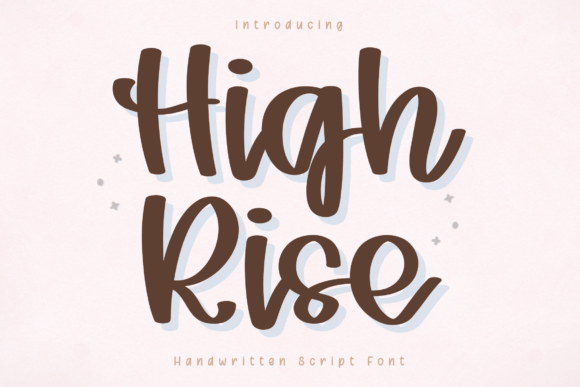
High Rise is classified as a soft and friendly handwritten script. Unlike formal calligraphy fonts that mimic copperplate or brush pen strokes with sharp contrast between thick and thin lines, High Rise opts for a more relaxed approach. Its design features smooth curves and slightly rounded letterforms. This gives the typeface a "warm" personality, making it feel approachable rather than elegant or austere.
The distinctiveness of High Rise lies in its consistency. Many handwritten fonts suffer from irregular baselines or exaggerated loops that, while beautiful, can render text difficult to read at smaller sizes. High Rise maintains a clean and consistent stroke width throughout. This uniformity ensures that when the text is scaled down for a business card or a planner label, the letters do not bleed together. It strikes a balance that is often difficult to find: it looks handwritten enough to feel personal, but structured enough to feel professional.
Technical Performance: Cutting and Digital Rendering
One of the primary reasons creatives evaluate fonts like High Rise is for compatibility with cutting machines such as Cricut or Silhouette. This is a critical technical evaluation point. Highly detailed fonts with excessive "swashes" (decorative tails on letters) often snag cutting blades or result in messy cuts on vinyl or cardstock.
High Rise is engineered with smooth performance in mind. The strokes are clean, avoiding the microscopic jagged edges that can cause issues in vector rendering. For users who work with adhesive vinyl, heat transfer vinyl (HTV), or paper cutting, this reliability is a significant advantage. It minimizes the time spent "weeding" (removing excess material) and reduces material waste.
Furthermore, in the digital realm, High Rise renders well on screens. Because it avoids ultra-thin hairlines, it remains legible on mobile devices and tablets. This makes it a strong contender for digital planners and user interface elements where readability is paramount.
Evaluating Tradeoffs: Legibility vs. Artistic Flair
When comparing High Rise to other script categories, it is helpful to understand the tradeoffs involved in its design choices.
- The "Neat" Factor: High Rise prioritizes neatness. If a project requires a font that mimics the raw, chaotic energy of a hurried signature, High Rise may feel too polished. It lacks the "grunge" texture or the erratic baseline of more artistic, expressive fonts.
- Connectivity: A common issue in script fonts is how letters connect. High Rise generally offers smooth connections between letters, creating a fluid flow. However, unlike some premium script fonts that offer "contextual alternates" (changing the shape of a letter based on what comes before or after it), High Rise maintains a more standard connection style. This ensures consistency but may feel repetitive in very large blocks of text.
- Spacing: The font features generous spacing. This is excellent for readability but may require manual kerning adjustment if you are trying to create extremely tight, overlapping headline effects common in modern logo design.
Best-Fit Scenarios for High Rise
Determining if High Rise is the right resource for your project requires looking at specific use cases. Based on its design attributes, here are the scenarios where this font tends to perform best:
Cricut and DIY Crafting
As mentioned, the clean strokes make it ideal for physical crafting. Whether you are creating custom tumblers, tote bags, or greeting cards, the font provides a handmade look without the frustration of difficult cuts. It is particularly effective for "single-line" style projects where legibility is the top priority.
Branding for Approachable Businesses
For small businesses in the lifestyle, wellness, or children’s sectors, High Rise offers a friendly face. It works well for logos that need to convey trust and warmth without looking childish. It pairs effectively with clean sans-serif fonts (like Montserrat or Lato) to create a balanced visual hierarchy where High Rise handles the accent text and the sans-serif handles the body copy.
Social Media Graphics
On platforms like Instagram or Pinterest, text needs to be readable within seconds. High Rise’s clarity makes it a solid choice for quote graphics or promotional banners. It adds personality to the post without forcing the user to squint to decipher the message.
Digital Planning and Organization
For users of apps like GoodNotes or Notability, High Rise can be used for headers and labels. It mimics the look of a neat handwritten label without the inconsistency of actual handwriting, helping to keep digital planners looking organized and aesthetically pleasing.
When to Consider Alternatives
While High Rise is a versatile tool, there are situations where a different type of resource might be necessary.
- For Formal Events: If you are designing for a luxury gala, a high-end law firm, or a sophisticated architectural brand, High Rise is likely too casual. In these cases, a classic serif (like Garamond) or a formal calligraphy script would be more appropriate to convey authority and tradition.
- For Large Body Text: No script font, regardless of how clean it is, should be used for long paragraphs. The eye tires quickly of reading continuous cursive. If you need to write a full blog post or a flyer with detailed information, High Rise should be reserved strictly for the headline, while a readable sans-serif or serif should handle the rest.
- For "Edgy" Aesthetics: If the project demands a grunge, retro, or streetwear aesthetic, the soft and friendly nature of High Rise will conflict with the visual tone. You would need a font with more texture, distortion, or geometric sharpness.
Decision Factors: How to Choose
When evaluating High Rise against your current inventory of fonts, consider these three factors:
- Technical Compatibility: Does your primary workflow involve cutting machines? If yes, High Rise is a low-risk addition due to its optimized vector paths.
- Audience Perception: Who is looking at the design? If your audience values approachability and friendliness (e.g., parents, hobbyists, wellness clients), the font aligns with their expectations. If they value exclusivity and luxury, it does not.
- Pairing Potential: Look at the fonts you already own. High Rise pairs best with geometric sans-serifs. If your library is full of decorative display fonts, adding another script might create clutter rather than utility.
Conclusion
High Rise represents a practical solution for creatives who need the aesthetic of handwriting without the unpredictability of manual drawing or the technical failures of poorly digitized fonts. It is a workhorse font—perhaps not the most dramatic option for a movie poster, but arguably one of the most reliable for everyday creative applications. By understanding its strengths in legibility and cutting performance, and acknowledging its limitations in high-formality contexts, you can make a more informed decision about whether High Rise belongs in your creative toolkit.