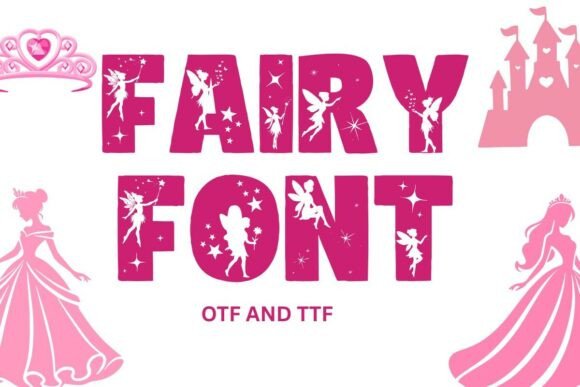
Fairy Font: A Practical Look at a Whimsical Typeface for Creative Projects
Understanding the Core Appeal of Fairy
In the vast landscape of digital typography, finding a font that strikes a specific chord can be a challenge. Fairy is a typeface that positions itself in a distinct niche: the intersection of fantasy, whimsy, and clean vector design. It’s not a workhorse font for body text; instead, it’s a specialized tool designed for impact. The font’s character set is deliberately limited to uppercase A-Z and numerals 0-9, a constraint that immediately defines its purpose. This isn’t a limitation but a focused design choice, steering users toward its ideal application—bold, statement-making headlines, titles, and graphic elements where a touch of magic is required.
The fundamental value proposition of Fairy lies in its ability to inject a specific mood instantly. For creators, entrepreneurs, and marketers, the right typeface does more than convey words; it communicates a brand’s personality, a project’s theme, or an event’s atmosphere. Fairy is engineered to evoke enchantment, fantasy, and playful sophistication. Its crisp vector outlines ensure that this aesthetic isn’t lost at scale, whether on a small social media graphic or a large-format print. This makes it a practical asset for professionals who need reliable quality across various mediums.
Key Characteristics and Practical Strengths
Evaluating Fairy beyond its surface charm reveals several practical strengths. The fantasy-inspired style is consistent throughout its uppercase letters and numbers, creating a cohesive visual language. This consistency is crucial for branding and design projects where visual harmony is non-negotiable. The clean vector construction is a significant technical advantage, preventing the pixelation or blurriness that can plague less refined display fonts, especially when used in high-resolution printing or digital scaling.
Another notable strength is its performance on diverse backgrounds. The design’s clarity allows it to maintain legibility and aesthetic appeal on both light and dark canvases. This versatility is a practical benefit for designers working across different platforms, from websites and apps to printed materials with varying color schemes. The ease of installation and use across standard design software further reduces friction, allowing it to integrate smoothly into existing workflows.
- Primary Use Case: Ideal for creating enchanting titles for children’s books, fantasy-themed event invitations, magical branding for boutique businesses, or whimsical social media headers.
- Technical Quality: Vector-based outlines ensure scalability without quality loss, a key consideration for professional print and digital applications.
- Visual Consistency: The uniform fantasy aesthetic across all glyphs helps maintain a strong, coherent theme in any project.
Real-World Application and Compatibility
The true test of any creative asset is its performance in a real-world workflow. Fairy is designed to be compatible with a broad range of popular design platforms, including Canva, Cricut Design Space, Silhouette Studio, Photoshop, Illustrator, Affinity, and Procreate. This wide compatibility is a major plus for freelancers and small business owners who may use different tools for different tasks. It ensures that the font can be a shared resource across a team or a versatile tool in a solo creator’s arsenal.
For example, a small business owner creating a line of fantasy-themed merchandise could use Fairy in Adobe Illustrator for product mockups, then seamlessly use the same font in Canva for social media promotion, and finally load it into Cricut Design Space for physical crafting. This cross-platform reliability streamlines the production process and ensures brand consistency from digital concept to physical product.
However, its limitations are part of its practical profile. The absence of lowercase letters, punctuation, and special characters means it cannot be used for long-form text or content requiring complex typographic detail. This is a critical consideration. A blogger would not use Fairy for their article body, but might use it for a stylized blog post title or a featured graphic. Educators could use it to create engaging, themed headers for classroom materials, but would need a complementary, more conventional font for instructional text.
Who Benefits Most from Fairy?
Fairy finds its most natural audience among those who need to make a strong, thematic impression quickly and visually. Its utility is highest in contexts where the feel of the text is as important as its meaning.
- Marketers and Brand Strategists: Perfect for crafting campaign assets for products in the toy, game, entertainment, or lifestyle sectors that want to project a sense of wonder or imagination.
- Event Planners and Stationers: Excellent for designing invitations, menus, and signage for themed weddings, children’s parties, or fantasy conventions.
- Content Creators and Bloggers: A valuable tool for creating standout YouTube thumbnails, podcast cover art, or Pinterest graphics that need to capture attention in a crowded feed.
- Crafters and Hobbyists: With its compatibility with Cricut and Silhouette, it’s a direct asset for creating personalized decals, apparel, and home decor with a magical flair.
- Small Business Owners: Ideal for boutique brands—think a fantasy-themed bookstore, a mystical cosmetics line, or a children’s storytelling service—to develop a distinctive visual identity.
Evaluating Long-Term Value and Considerations
When considering Fairy for long-term use, its value is tied to the longevity of your projects and the consistency of your thematic needs. If your work regularly requires a whimsical, fantasy-inspired aesthetic, it becomes a reliable part of your design toolkit. Its vector quality ensures it won’t degrade over time or with technological advancements in display and print. The font’s effectiveness is directly proportional to its appropriate application; using it in the right context yields professional, charming results, while misapplication can appear incongruous or unprofessional.
A balanced recommendation is to view Fairy as a specialized accent font. It rarely stands alone in a complete design system but excels as a headline or display element paired with a neutral, readable body font. Its strength is in its specificity. For a project that requires a universal typeface with extensive character sets, Fairy is not the solution. But for the specific, recurring need to add a layer of enchantment, it offers a focused, high-quality, and practical solution that can elevate the right creative project from ordinary to memorable.
Ultimately, Fairy is a purpose-built tool. Its design choices are intentional, its technical specs are sound, and its compatibility is broad. For the professional or serious hobbyist who understands and needs its specific magic, it represents a straightforward and effective investment in their creative resources.