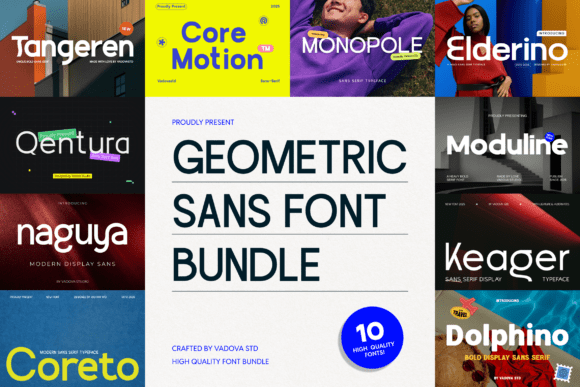
Evaluating the Geometric Sans Bundle for Modern Design Systems
In the search for reliable typographic foundations, designers and brand strategists often encounter collections like the Geometric Sans Bundle. This category of fonts is characterized by mathematical precision, clean lines, and a structural clarity that appeals to contemporary visual trends. However, selecting the right typeface collection involves more than just aesthetic appreciation; it requires an evaluation of functionality, versatility, and long-term viability across various platforms. This analysis explores the core attributes of geometric sans-serif bundles, helping you determine if this style aligns with your specific project requirements and professional goals.
Analyzing the Core Characteristics
At its heart, a Geometric Sans Bundle typically consists of typefaces built upon geometric forms—circles, squares, and triangles. This construction method results in letters with even stroke widths and minimal contrast, creating a rhythm that feels orderly and modern. When evaluating such a bundle, it is essential to look beyond the initial "clean" appearance and examine the specific design choices made within the letterforms.
For instance, the construction of the lowercase 'a' or 'g' can reveal the font's personality. A double-story 'g' offers a more traditional feel, while a single-story 'g' leans toward a more futuristic or industrial aesthetic. Similarly, the terminal shapes—whether they are perfectly round or slightly tapered—affect how the text feels when read in long paragraphs. A high-quality bundle will offer these nuances, ensuring that the geometric foundation does not result in a sterile or robotic appearance, but rather one that is functional and adaptable.
The Versatility Factor in Branding and UI
One of the primary reasons professionals seek out a Geometric Sans Bundle is for its perceived versatility. These typefaces are often viewed as "chameleons" of the design world, capable of adapting to different contexts without stealing focus from the content they present.
In the realm of User Interface (UI) and web design, geometric sans-serifs are frequently favored for their legibility on digital screens. The open letterforms and consistent spacing make them excellent for body text, navigation menus, and data visualization. When evaluating a bundle for digital use, consider the font's performance at small sizes. Do the counters (the enclosed spaces within letters like 'o' or 'e') remain open? Does the font maintain its integrity when rendered on low-resolution screens?
For branding, the appeal lies in neutrality. A geometric sans-serif can act as a blank canvas, allowing the brand's imagery and messaging to take center stage. However, this neutrality can also be a tradeoff. If a brand requires a distinct voice or a strong emotional trigger, a purely geometric approach might feel too generic. Therefore, the decision to use a Geometric Sans Bundle should be weighed against the need for a unique brand personality.
Evaluating Tradeoffs and Practical Considerations
While the benefits of clarity and modernity are significant, there are practical considerations to weigh. One common tradeoff with geometric fonts is readability in long-form text. Because the letterforms are so uniform, they can sometimes create a "dull" texture on the page, making it harder for the eye to track lines of text compared to humanist sans-serifs, which have more variation in stroke width.
When selecting a Geometric Sans Bundle, pay close attention to the weight range provided. A robust bundle should offer a wide spectrum of weights—from thin and hairline to ultra-bold and black—along with corresponding italic styles. If the bundle lacks these variations, you may find your design system constrained when trying to create visual hierarchy. Additionally, check for OpenType features such as ligatures, stylistic alternates, and numeral variations (lining vs. old-style), which add depth and functionality to the typeface.
Strategic Fit: When to Choose Geometric Sans
Determining whether a Geometric Sans Bundle is the right investment depends on the nature of your projects. These fonts are a strong fit for:
- Corporate Identities: Companies aiming for a look of efficiency, transparency, and innovation often benefit from the structured nature of geometric fonts.
- Minimalist Design: If your aesthetic relies on whitespace and grid-based layouts, geometric sans-serifs complement this approach perfectly.
- Large-Scale Signage: Due to their simple construction, these fonts scale up effectively for environmental graphics and wayfinding systems.
However, there are scenarios where alternatives might be worth considering. If you are designing a book, a literary magazine, or a luxury brand that relies on heritage and tradition, a serif typeface or a humanist sans-serif might convey the appropriate tone more effectively. The precision of geometric fonts can sometimes feel cold or impersonal in contexts that require warmth and intimacy.
Conclusion: Making the Decision
Ultimately, the decision to integrate a Geometric Sans Bundle into your toolkit is a strategic one. It is an investment in clarity, modernity, and structural integrity. By carefully evaluating the specific design details of the letterforms, testing their performance across different media, and weighing the tradeoffs regarding personality and readability, you can make an informed choice. If your goal is to create visuals that feel sleek, confident, and well-crafted without overwhelming the content, a geometric sans-serif collection is likely a reliable and flexible foundation for your work.