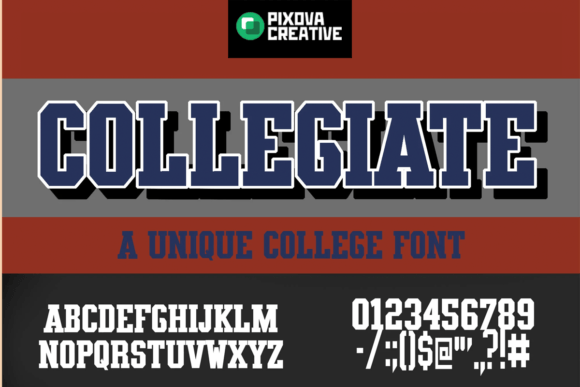
Understanding the Collegiate Font: A Guide to Academic Aesthetic
In the world of graphic design and branding, typography is rarely just about legibility; it is about voice. The typeface chosen for a logo, a poster, or a website header communicates a specific history and emotion before the reader even processes the words. For organizations rooted in education, athletics, and tradition, finding a typeface that balances authority with style is a significant challenge. This is where the Collegiate font enters the conversation, offering a distinct solution for designers and administrators seeking to bridge the gap between historical prestige and modern clarity.
The Challenge of Institutional Branding
Universities, colleges, and secondary schools face a unique branding dilemma. They must appeal to prospective students who expect modernity and innovation while simultaneously reassuring alumni and donors that the institution remains grounded in tradition and excellence. A brand that looks too modern may feel transient or lacking in history. Conversely, a brand that relies too heavily on archaic serif fonts may appear outdated or inaccessible to a new generation of digital natives.
This tension often leaves decision-makers searching for a visual language that feels "timeless" rather than "dated." The goal is to evoke the ivy-covered walls and the solemnity of graduation ceremonies while maintaining a sharp, competitive edge in a crowded educational marketplace. Traditional serif fonts can sometimes feel too stiff or corporate, while standard sans-serifs often lack the distinctiveness required to build a memorable institutional identity.
Defining the Collegiate Aesthetic
The Collegiate font is designed specifically to address this duality. At its core, it is a typeface that embraces the classic American collegiate aesthetic—often characterized by bold, blocky serifs and high-contrast strokes—but refines it through hand-crafted precision. Unlike generic system fonts, Collegiate possesses an organic quality. It avoids the rigid, mechanical perfection of digital rendering, instead offering a warmth that suggests human touch and craftsmanship.
This font does not merely replicate the past; it reinterprets it. It merges the structural integrity of traditional academic typography with contemporary spacing and proportion. The result is a typeface that feels familiar yet distinct, making Collegiate an ideal candidate for institutions looking to refresh their image without abandoning their heritage.
Practical Applications and Use Cases
The utility of the Collegiate font extends far beyond the university letterhead. Its versatility allows it to function effectively across various media and platforms, solving specific design problems for different user groups.
Athletic and Spirit Wear
Perhaps the most immediate application for Collegiate is in athletics. Sports teams rely on bold, aggressive typography to convey strength and competitiveness. This font provides the necessary visual impact for jerseys, helmets, and fan merchandise. Because it avoids looking generic, using Collegiate helps a school’s athletic brand stand out against competitors who may be using overused, standard "varsity" fonts.
Event Branding and Graduation Materials
For event planners and administrators, the font serves as a shorthand for ceremony and significance. When used on graduation programs, diplomas, or alumni event invitations, Collegiate elevates the perceived value of the document. It signals to the recipient that the event is formal and important, reinforcing the prestige of the institution.
Digital Presence and Web Design
In the digital realm, headers and hero images require typefaces that are impactful at large sizes. Collegiate excels in this environment. It can be used for website headers to immediately establish the site's educational context. However, designers must be mindful of legibility; while excellent for headlines, such decorative fonts are best reserved for display text rather than body copy.
Different Approaches for Different Users
The implementation of Collegiate will vary depending on the specific goals of the user. A marketing director at a large university will use the font differently than a freelance designer creating a logo for a local tutoring center.
For the university marketing team, Collegiate might serve as a secondary typeface. It can be paired with a clean, professional sans-serif font. In this context, the font is used to inject personality into headlines or pull quotes, while the sans-serif handles the heavy lifting of body text. This approach ensures readability while maintaining the academic vibe.
For the independent school or tutoring service, the font might take center stage. These organizations often need to establish authority quickly. A logo featuring Collegiate can instantly communicate "education" and "expertise" to parents and students. In this scenario, the font acts as a primary identifier, anchoring the brand's visual identity.
Furthermore, graphic designers working on merchandise or apparel may choose to manipulate the font creatively. Because Collegiate is designed with a hand-crafted feel, it can often withstand artistic distortion—such as arching text, adding outlines, or incorporating textures—better than rigid, geometric fonts. This flexibility allows for the creation of dynamic, eye-catching spirit wear.
Implementation Tips and Considerations
To maximize the effectiveness of the Collegiate font, several practical considerations should be kept in mind during the design process.
- Pairing and Contrast: As mentioned, Collegiate works best when paired with a simpler typeface. A high-contrast pairing—such as using Collegiate for headers and a geometric sans-serif for body text—creates a visual hierarchy that guides the reader's eye. Avoid pairing it with other highly decorative fonts, as this can result in visual clutter.
- Color Palette: The font resonates deeply with classic color schemes. Deep navy, rich crimson, forest green, and gold often complement the academic feel of Collegiate. However, using the font in stark black and white can also create a powerful, newspaper-style aesthetic that feels authoritative and urgent.
- Spacing and Kerning: Because display fonts often have unique character shapes, manual kerning (adjusting the space between specific pairs of letters) is frequently necessary. Ensuring that the spacing between letters in Collegiate is visually even is crucial for a professional look, particularly in logos.
- Contextual Awareness: While the font is versatile, it is still stylistically specific. It is the perfect fit for a College of Law or a Business School, but it might feel out of place for a cutting-edge robotics lab or an avant-garde art gallery. Understanding the specific "flavor" of the institution helps determine if Collegiate is the right tool for the job.
The Outcome: Tradition Meets Modernity
Ultimately, the value of the Collegiate font lies in its ability to solve a complex branding equation. It allows organizations to tap into the collective nostalgia associated with higher education—the sense of community, history, and intellectual pursuit—without feeling stuck in the past.
By choosing Collegiate, designers and administrators are making a deliberate choice to prioritize character and craftsmanship. It transforms standard text into a visual statement of excellence. Whether used on a massive stadium banner, a sophisticated alumni magazine, or a digital ad campaign, the font consistently delivers a message of prestige and quality. For any project that requires a scholarly yet stylish touch, Collegiate remains a robust and reliable solution.