Reviving the Golden Age: Unlocking Design Potential with Way to Alaska
The Challenge of Authentic Vintage Aesthetics
In the modern design landscape, there is a distinct hunger for nostalgia. Whether it is the resurgence of craft breweries, the rise of artisanal goods, or the popularity of retro gaming aesthetics, the visual language of the past is more relevant than ever. However, designers often face a significant hurdle: authenticity. Attempting to recreate the look of a 1950s roadside diner or a weathered general store label using generic fonts often results in designs that look "digital" and lifeless. The challenge lies in finding typography that carries the texture, weight, and imperfections of real-world vintage printing without requiring hours of manual vector manipulation.
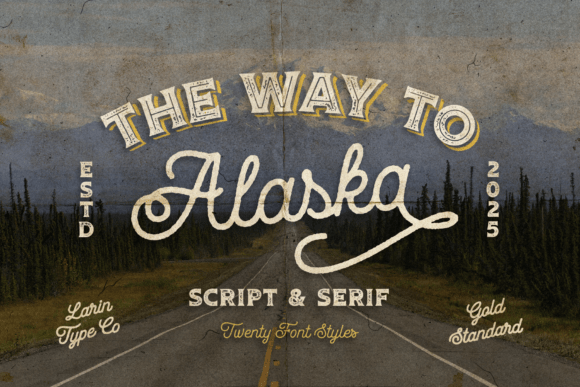
This is where Way to Alaska enters the conversation. It is not merely a typeface; it is a curated vintage font collection specifically engineered to bridge the gap between digital convenience and analog authenticity. Inspired by the rugged charm of old signboards, weathered labels, and bold banners, this collection addresses the need for typography that feels lived-in and historically grounded.
Understanding the Way to Alaska Collection
To truly grasp how Way to Alaska can transform a project, one must understand its structure. The collection is not a single monolithic font but rather a comprehensive toolkit comprising 20 distinct font styles. This variety is essential because "vintage" is not a monolith; a 1920s circus poster looks vastly different from a 1960s garage label, and Way to Alaska acknowledges this diversity.
The collection is divided into two primary categories: Serif and Script. Each category has been meticulously designed to offer specific moods and textures:
- The Serif Family: This is the backbone of the collection, featuring a heavy, grounded presence. It includes styles like Regular, Rough, and Inline. However, the true utility lies in the variations. The "Rough" and "Halftone" styles mimic the ink bleed and texture of old screen printing, while the "Shadow" and "Inline" variants allow for complex, multi-layered typography reminiscent of classic hand-painted signage.
- The Script Family: Flowing and expressive, the script fonts offer a handwritten quality that feels personal. With styles ranging from Regular to Bold and Rough, this side of the collection captures the fluidity of hand-lettering seen on vintage cafe menus and liquor labels.
Practical Applications: Where Design Meets Utility
The value of Way to Alaska lies in its practical application across various industries. For graphic designers working in branding, the collection solves the problem of "flat" logo design. By utilizing the "Stamp" or "Inline Rough" styles, a designer can instantly give a new brand the patina of age, suggesting stability and tradition. This is particularly useful for startups in the food and beverage industry, outdoor apparel, or heritage crafts, where conveying a sense of history is a key business goal.
Consider the scenario of a craft beer label. A designer needs to communicate that the product is traditional yet bold. Using the Way to Alaska Serif in its "Halftone" style can replicate the look of an old lithograph print. Conversely, if the goal is to create a cozy, hand-made feel for a bakery logo, the Script family’s "Regular" or "Bold" styles provide the necessary warmth and fluidity.
Maximizing Customization with Alternates
A common frustration with decorative fonts is the repetition of characters, which breaks the illusion of hand-crafted work. Way to Alaska addresses this specific pain point through an extensive library of alternates. The script font, in particular, includes a wealth of alternative uppercase and lowercase characters.
This feature is crucial for users aiming for high-end typography. When designing a headline or a logo, a user can cycle through different versions of the letter "a" or "g" to ensure the flow of the text looks natural and unforced. This level of customization allows the designer to act more like a sign painter, making deliberate choices about how letters interact, rather than simply typing out a string of identical characters.
Different Approaches for Different Goals
Not every user approaches a vintage font collection with the same intent, and Way to Alaska accommodates various workflows. A web designer might use the "Regular" styles for headers that need to be legible on screens while maintaining a retro vibe. In contrast, a print designer creating a poster for a blues festival might lean heavily into the "Shadow" and "Stamp" styles to create high-contrast, tactile imagery that jumps off the paper.
Furthermore, the inclusion of "Cores" as a separate style allows for advanced layering. A user might stack the "Inline" style on top of the "Shadow" style, using different colors to create a multi-dimensional effect. This approach turns the text into a graphic element itself, solving the problem of empty space in layout design and adding significant visual interest without the need for additional illustrations.
Implementation and Best Practices
To get the most out of Way to Alaska, it is helpful to consider the context of the design. Because the fonts are rich in detail and texture, they perform best at larger sizes. Using the "Halftone" or "Rough" styles for small body text can result in legibility issues; therefore, pairing these display fonts with a clean, simple sans-serif for the body copy is a recommended strategy.
Additionally, color choice plays a significant role in the success of these fonts. Vintage palettes often rely on muted earth tones, creams, and deep primary colors. When applying Way to Alaska to a design, utilizing a textured background—such as recycled paper or subtle noise—can further enhance the realism of the "Rough" and "Stamp" styles.
Conclusion
In an era where digital perfection can sometimes feel sterile, Way to Alaska offers a return to craftsmanship. It provides a solution for designers seeking to imbue their work with character, history, and soul. By offering a diverse range of styles from Serif to Script, and by equipping users with the tools for deep customization through alternates and layering, this collection serves as a versatile asset for anyone looking to master the art of vintage typography. Whether the goal is to build a brand identity from scratch or to add a retro flair to an existing project, Way to Alaska