Galaxy War: Integrating a Bold Sci-Fi Display Font into Professional Design Workflows
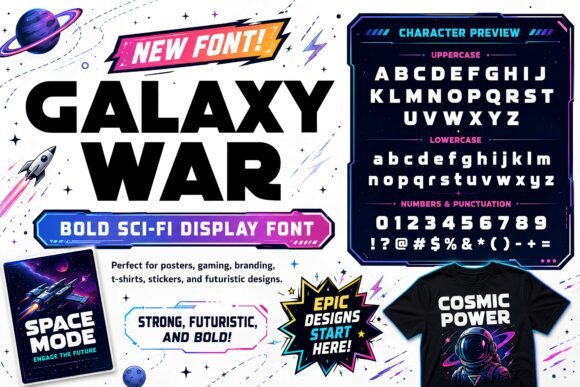
In the landscape of digital design, typography is rarely just about selecting a letter shape; it is about defining the voice and visual gravity of a project. Galaxy War is a bold sci-fi display font engineered with sharp geometric shapes and powerful letterforms. It is not designed to be a body copy workhorse, but rather a high-impact visual asset for specific contexts. Understanding where and how to deploy a typeface like Galaxy War is crucial for professionals who value efficiency and visual consistency. This font is tailored for modern space-themed designs, gaming posters, esports branding, movie titles, t-shirt designs, stickers, logos, packaging, and futuristic merchandise.
Defining the Asset: Characteristics of Galaxy War
Before integrating any asset into a workflow, one must understand its inherent properties. Galaxy War is built on a foundation of sharp geometry. The letterforms rely on angular cuts, straight lines, and structured curves that evoke a sense of industrial precision and high technology. Unlike serif fonts that suggest history or handwritten scripts that suggest intimacy, Galaxy War communicates power, speed, and authority.
The font’s aesthetic is distinctly "futuristic," but it avoids the retro-futurism of the 1980s in favor of a cleaner, more aggressive modern look. This makes it highly versatile for current digital trends. The dynamic look ensures that text does not merely sit on a surface but feels like a structural component of the design. For designers, gamers, and creators, this font serves as a focal point, demanding attention without requiring excessive embellishment to stand out.
Strategic Placement in the Design Process
Typography selection should happen early in the creative process, but the specific application of a display font like Galaxy War often requires a phased approach. Using a high-impact font effectively requires planning to ensure it does not clash with other visual elements.
Phase 1: Conceptualization and Mood Boarding
Galaxy War fits into the pre-production phase when defining the tone of a project. If a client requests a "high-tech," "aggressive," or "cosmic" vibe, Galaxy War should be introduced during the mood boarding stage. It sets the visual anchor for the rest of the design language. When presenting concepts to stakeholders, using Galaxy War in initial mockups can immediately convey the intended futuristic atmosphere, saving time on revisions later.
Phase 2: Execution and Hierarchy
During the execution phase, Galaxy War is best utilized for hierarchy management. In a layout involving a poster or packaging, the font should be reserved for headlines, sub-headlines, or logos. It is not intended for paragraphs of text. A practical workflow involves setting your primary headline in Galaxy War, then selecting a highly legible sans-serif font for the supporting copy. This contrast creates a balanced composition where the display font provides the "punch" and the body text provides the readability.
Phase 3: Merchandise and Production
In the post-design phase, specifically for physical production, the sharpness of Galaxy War is a distinct advantage. For t-shirt designs, stickers, and packaging, the clean geometric edges of the font translate well to various printing methods, including screen printing and die-cutting. The bold nature of the letterforms ensures that the text remains legible even on moving targets, such as esports jerseys or merchandise viewed from a distance.
Integration with Tools and Platforms
A font does not exist in a vacuum. It must interact with other software and resources. Galaxy War is designed to be compatible with standard vector and raster workflows, but specific considerations can improve efficiency.
- Vector Software (Illustrator, Affinity Designer): Because Galaxy War relies on geometric shapes, it pairs exceptionally well with vector environments. Designers can easily manipulate the anchor points of the letters to create custom kerning or extended ligatures for logos. The font’s structure allows for easy separation of elements if you wish to apply gradient effects or 3D extrusions to individual letters.
- Raster Software (Photoshop): When used in Photoshop for movie titles or gaming posters, Galaxy War interacts well with layer styles. Its bold weight holds up against heavy drop shadows, outer glows, and texture overlays without losing structural integrity. It serves as a strong base layer for text effects that might otherwise distort thinner typefaces.
- Web and UI Platforms: While primarily a display font, Galaxy War can be used in web headers or hero sections for tech-focused landing pages. However, implementation requires careful optimization to ensure page load speeds are not compromised, as display fonts often carry larger file sizes than standard web fonts.
Practical Implementation and Workflow Examples
Integrating Galaxy War effectively means understanding the specific use cases where its geometry shines. Below are practical scenarios for different types of creators.
Esports Branding and Gaming
For esports teams or gaming content creators, consistency across platforms is vital. A workflow for branding might involve creating a primary logo using Galaxy War. Once the logo lockup is established, the designer should extract the specific color codes and sizing ratios used with the font to create a style guide. This ensures that when the team creates overlays for streaming or social media assets, the typography remains consistent. The "bold, powerful" nature of the font helps establish a professional, competitive identity.
Futuristic Merchandise and Packaging
When designing packaging for tech products or futuristic merchandise, the unboxing experience matters. Galaxy War can be used on the exterior packaging to signal innovation. A practical tip is to use the font in all-caps for maximum impact, but increase the tracking (letter spacing) slightly. This prevents the sharp geometric shapes from merging visually at smaller sizes. For t-shirt designs, placing a single, large word in Galaxy War across the chest creates a minimalist but high-impact statement.
Movie Titles and Event Posters
In editorial or event design, typography drives the narrative. For a sci-fi movie title or a technology conference poster, Galaxy War should be the visual anchor. A useful process is to create a "type lockup" where the title is arranged in a specific shape—such as a pyramid or a horizontal block—using the font’s geometry to guide the composition. This creates a custom feel that goes beyond simply typing out the words.
Compatibility and Quality Control
When working with strong geometric fonts, quality control is essential. The sharp points and straight lines of Galaxy War can sometimes create visual tension if not spaced correctly.
Kerning and Tracking: Always manually check the kerning between specific letter pairs. In sci-fi fonts, pairs like "AV," "WA," or "LT" often require manual adjustment to look optically correct. Ignoring this can make a professional design look amateurish.
Resolution and Scaling: Because the font features sharp edges, it performs best in high-resolution environments. If used in low-resolution web graphics, the aliasing (jagged edges) can become prominent. Always use vector formats (SVG) for web implementation to maintain the crispness of the design.
Color Contrast: Galaxy War is a "strong" font, meaning it can dominate a layout. Ensure that the background it sits on has sufficient contrast. It works best against dark, moody backgrounds (deep space blues, blacks) or vibrant, high-energy gradients. Avoid placing it on busy, textured backgrounds where the letterforms might get lost.
Long-Term Use and Brand Consistency
For entrepreneurs and small business owners, investing in a font like Galaxy War is an investment in brand equity. If the brand identity is centered around technology, innovation, or entertainment, this font becomes a core asset.
Over time, the consistent use of Galaxy War across invoices, social media, website headers, and physical merchandise builds a recognizable visual language. It signals to the audience that the brand is modern and forward-thinking. However, it is important to pair it with a secondary typeface that handles the heavy lifting of daily communication (emails, contracts, blog posts). Using Galaxy War sparingly for impact ensures it retains its power and does not become visually fatiguing to the audience.
Ultimately, Galaxy War is more than just a collection of letters; it is a tool for creating atmosphere. By integrating it thoughtfully into the design process—from concept to final production—creators can leverage its geometric precision to build bold, high-tech visuals that stand out in a crowded marketplace.